

Blog by Margherita Poles, SI Representative to the AI for Good Global Summit and WSIS Forum in Geneva.
Artificial intelligence is advancing at extraordinary speed, while access to digital opportunities remains uneven. According to the International Telecommunication Union, around 2.2 billion people remain offline, with the largest share living in low- and middle-income countries. Meaningful participation also depends on affordability, digital skills, accessibility, language, relevant content and effective public governance.
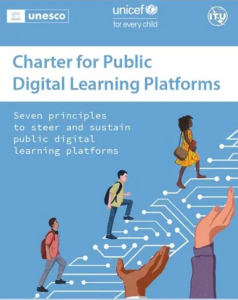 One of the most interesting discussions I attended whilst participating in the WSIS Forum and AI for Good in Geneva was an introduction to the Gateways to Public Digital Learning Initiative, led by UNESCO, UNICEF and ITU.
The initiative supports countries in developing equitable digital commons for education: public platforms that provide quality-assured, curriculum-aligned and age-appropriate learning materials. Its broader purpose is to ensure that education remains a public good and a human right across digital and online environments.
By fostering international collaboration, the initiative helps strengthen digital learning commons at both national and subnational levels.
This approach is closely aligned with the UNESCO 2019 Recommendation on Open Educational Resources (OER), which defines OER as learning, teaching and research materials in the public domain or released under open licences, allowing free access, reuse, adaptation and redistribution.
This means that teachers can translate lessons, adapt them for different age groups, introduce local examples and make them accessible to learners with disabilities. When combined with thoughtful digital architecture and artificial intelligence, OER can evolve from individual resources into adaptable learning infrastructure.
Multimodal AI creates further possibilities. Voice-based, visual and interactive tools can support children developing foundational literacy and numeracy skills. They can also widen access for learners who speak Indigenous or local languages with limited representation online.
This approach begins with the learner’s reality: language, literacy level, culture, infrastructure and learning environment. It shows how inclusive technology can engage people through formats they can understand and use.
The wider impact will depend on quality assurance, accessibility, local adaptation, public accountability and human oversight. Openness also strengthens digital sovereignty by giving countries and institutions greater capacity to understand, adapt and govern the technologies they use.
For Soroptimist, continued engagement in WSIS and AI for Good means contributing to the spaces where these choices are being shaped. It means advocating for gender-responsive AI literacy, inclusive educational resources, safer digital environments and greater representation of women in technological leadership.
I returned from Geneva with a stronger conviction that openness can become a practical pathway towards digital equality. Artificial intelligence can expand educational access, support teachers, bridge linguistic barriers and reach learners across geographic boundaries.
Digital transformation is already unfolding. Our shared responsibility is to shape it so that more people can access its opportunities, contribute to its development and lead its future.









