Blog by Tania Gómez Herazo, SI Advocacy AI Advisor and Pat Dale MBE, SI Representative to the Commonwealth
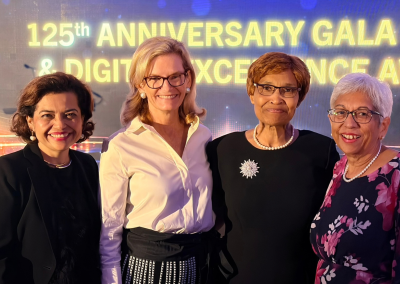
[Feature image, from left to right: Tania Gómez Herazo, SI AI Advisor. Doreen Bogdan-Martin, Secretary-General, International Telecommunication Union. Bernadette Lewis, Secretary-General, Commonwealth Telecommunications Organisation. Pat Dale, MBE SI Representative to the Commonwealth]
In 1901, Britain, Australia and New Zealand laid a submarine cable across the Pacific. It carried telegrams; it also carried something more durable, a habit of cooperation between nations of very different sizes. That habit became the Commonwealth Telecommunications Organisation, and on 30 September 2026 it turned 125.
We attended the session of the Ministerial Alliance for Digital Nations, followed by the Gala Dinner and Digital Excellence Awards. What follows is not a full recap, but what we believe matters most for Soroptimists, and for anyone working to make digital transformation deliver for everyone.
Morning: trust is built, not assumed
The session on Digital Trust, Internet Governance and Resilient Digital Economies covered vast ground, yet a single idea ran through it: the outcomes we want from technology are not automatic. They have to be designed.
Sovereignty, redefined. Tuvalu, a low-lying island nation facing the prospect of losing its land to the sea, has rewritten its constitution so that statehood rests on people, identity and culture rather than territory alone, and 26 countries have now recognised that principle. Its digital nation strategy places community values at the core. Few presentations have shown so clearly that technology must serve who we are, not the other way round.
Infrastructure as a public good. India’s minister reminded the room that more than 60% of the Commonwealth’s people are under 30 and set out what digital public infrastructure can do at scale: identity for 1.34 billion people, a payments system carrying roughly half the world’s real-time digital transactions, and data costs that have fallen by about 97% in a decade. His point is that digital sovereignty and an open internet are not opposites. Both can exist together.
Resilience is people. Joyce Dogniez of the Internet Society Foundation recalled the March 2024 undersea cable cuts that knocked West and Central Africa offline, and how engineers, governments and partners rerouted traffic together. Her conclusion was precise: infrastructure and capacity must grow together, and capacity development is not a supporting activity but a strategic investment. Sally Costerton of ICANN described the internet as “digital oxygen” and made the case that inclusion means participating in decisions, not merely being connected, including in one’s own language and script.
Mechanisms, not slogans. Professor David Eaves of UCL argued that governments transform not service by service, but by building shared infrastructure with standardised interfaces, and that public procurement is one of the most powerful levers to get there. Professor Michael Goldsmith of Oxford warned that AI is opening a new arms race between attackers and defenders, making cybersecurity capacity a national economic asset.
Safety by design. Anne Davidson, President of the National Council of Women of Great Britain, delivered the session’s most sobering contribution on the harms children and young women face online, and called for a legal duty of safety by design, with an offer to help build a Commonwealth model. As she put it, we would never release a toy, a medication or a car without safety standards; technology should be no different.
The question we brought to the room
On behalf of Soroptimist International, Tania asked the panel how leaders can ensure that investments in AI, cybersecurity and digital public infrastructure translate into shared economic growth, while creating real opportunities for all women and girls to participate, lead and shape the digital economy.
The answers formed a practical agenda. Safety by design, because women cannot lead in spaces where they are driven out by abuse. Visible role models and women leaders reaching out to one another, Sally Costerton from ICANN noted that the sector once felt
lonely and no longer does. And capacity building that produces confidence: Joyce Dogniez from Internet Society Foundation described women entrepreneurs in rural communities who, after technical training, finally feel they have a place at the table.
In her closing remarks, CTO Secretary-General Bernadette Lewis asked that the week be measured not by speeches, but by the partnerships formed, the initiatives launched and the results achieved together, and seven new partnerships were formalised during the week. She also reminded us that good outcomes are not automatic; they must be built-in by design.
Evening: excellence awards and real connections
The Gala celebrated 125 years with a documentary journey from cable to satellite to AI and then turned to the Digital Excellence Awards. Of 40 eligible submissions, each was reviewed independently by at least two judges against impact, innovation, sustainability, scalability, and implementation.
The winners told the story of a Commonwealth that is building, not waiting: a girls’ digital innovation programme in Nigeria taking young women from exclusion to digital agency; Pakistan’s National Incubation Centres; Botswana’s national computer emergency response team, which ran the country’s first national cyber drill; Rwanda’s Irembo, whose digital ambassadors have supported over 11 million applications for public services; and the UK’s Extract, an AI tool built inside government that turns two hours of planning-document processing into two minutes.
The judges also shared the story of a young Ugandan who won a CTO youth award in 2016 for a livestock app, a venture now developing agentic AI for farmers across rural Africa. Recognition, it turns out, can be an early investment.
Why this matters for Soroptimists
This event spoke directly to our pillars. Education and Empowerment, through capacity building, that turns access into confidence and leadership. Violence Against Women and Girls, through a growing consensus that safety must be engineered into technology from the start. And Health, through the recognition that digital harm is now a public-health issue for all of us, especially for young people.
These conversations also inform the roundtable on Women’s Health in the AI Era, convened by Soroptimist International and the Commonwealth on 9 October 2026. A cable
laid in 1901 connected nations. Our task now is to make sure the networks of the next 125 years connect all woman and girl, safely, meaningfully and as leaders.