

Blog by Pat Dale, SI Representative to the Commonwealth
London Climate Action Week 2026 brought together leaders, innovators, and civil society organisations committed to accelerating climate action at a decisive moment. As Soroptimist International continues to champion women’s leadership and community‑centred solutions, the week offered powerful reminders of how climate responsibility must evolve beyond statements of intent into measurable, inclusive impact.
Field to Future: Climate Resilience as a Pathway to Prosperity
At Newsweek’s Field to Future: Sustainable Wellness Summit, speakers highlighted the urgent need for climate‑smart approaches across agriculture, water, finance, and technology. The message was clear: climate change demands innovation, robust legislation, and a renewed focus on national and global security.
Professor Salma Abbasi, Tech Leader, Social Scientist and Transformation Champion for Inclusive and Sustainable Development at eWorldwide Group, delivered a compelling keynote. She emphasised that climate resilience should be viewed as an investment in prosperity. Resilient food systems, she noted, are the foundation of wellbeing, stability, and economic growth.
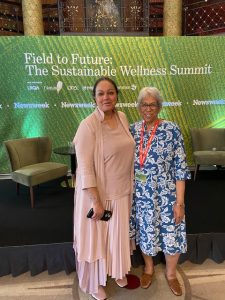
Left: Professor Salma Abbasi, Right: Pat Dale MBE. Image courtesy of Newsweek
Professor Abbasi underscored the transformative potential of:
- Artificial intelligence and precision agriculture
- Early warning systems for disaster preparedness
- Infrastructure, logistics, and market connectivity
These tools, she argued, can strengthen resilience and turn opportunity into prosperity. Crucially, she reminded participants that community resilience must sit at the core of every solution.
The event was moderated by Eileen Falkenberg-Hull, Senior Editor at Newsweek, who guided the panels with probing questions that kept the focus on accountability and action.
Commonwealth Clean Oceans Forum: Protecting Our Blue Planet
The second event of the week, organised by the Royal Commonwealth Society, centred on one of the most urgent environmental challenges of our time: plastic pollution across the Commonwealth.
Held at the Ismaili Centre in South Kensington, the Commonwealth Clean Oceans Forum 2026 brought together policymakers, scientists, innovators, and civil society leaders.
Keynote speaker Prince Hussain Aga Khan, a renowned nature photographer, shared his passion for marine life and the devastating impact of ocean pollution. His reflections on the fragility of underwater ecosystems and the promise of the blue economy set the tone for an afternoon of thoughtful dialogue.
Moderated by Janet Cooper OBE, the panel explored:
- Policy gaps in global plastics treaty negotiations
- The disproportionate impact of pollution on Small Island Developing States
- The role of innovation, design, and craft in shifting from disposability to circularity
Speakers included Richard Thompson OBE FRS, Pierre-Yves Paslier of Notpla, Cressida Bowyer, and Ofa Ma’asi Kaisamy of the Commonwealth Secretariat—each offering insights into how science, creativity, and community engagement can drive meaningful change. This is timely as every year, July marks Plastic Free Month.
Youth and Civil Society
Across the Commonwealth and beyond, I see young leaders, entrepreneurs and grassroots organisations driving innovation, holding institutions to account, and shaping solutions rooted in lived experience. They are not future leaders; they are leading now.
It is imperative that we actively invest in their capacity, amplify their voices and create meaningful pathways for participation in decision-making. Partnerships between the private sector and civil society must be strengthened to unlock this potential, fostering collaboration that is both equitable and action-oriented.
Climate action cannot succeed in isolation; it demands collective responsibility, shared purpose and sustained commitment. By aligning all stakeholders with the energy and insight of youth and civil society, we can accelerate progress towards a just, resilient and sustainable future for all.









