

Blog by Alice Paola Pomè, SI Youth Representative
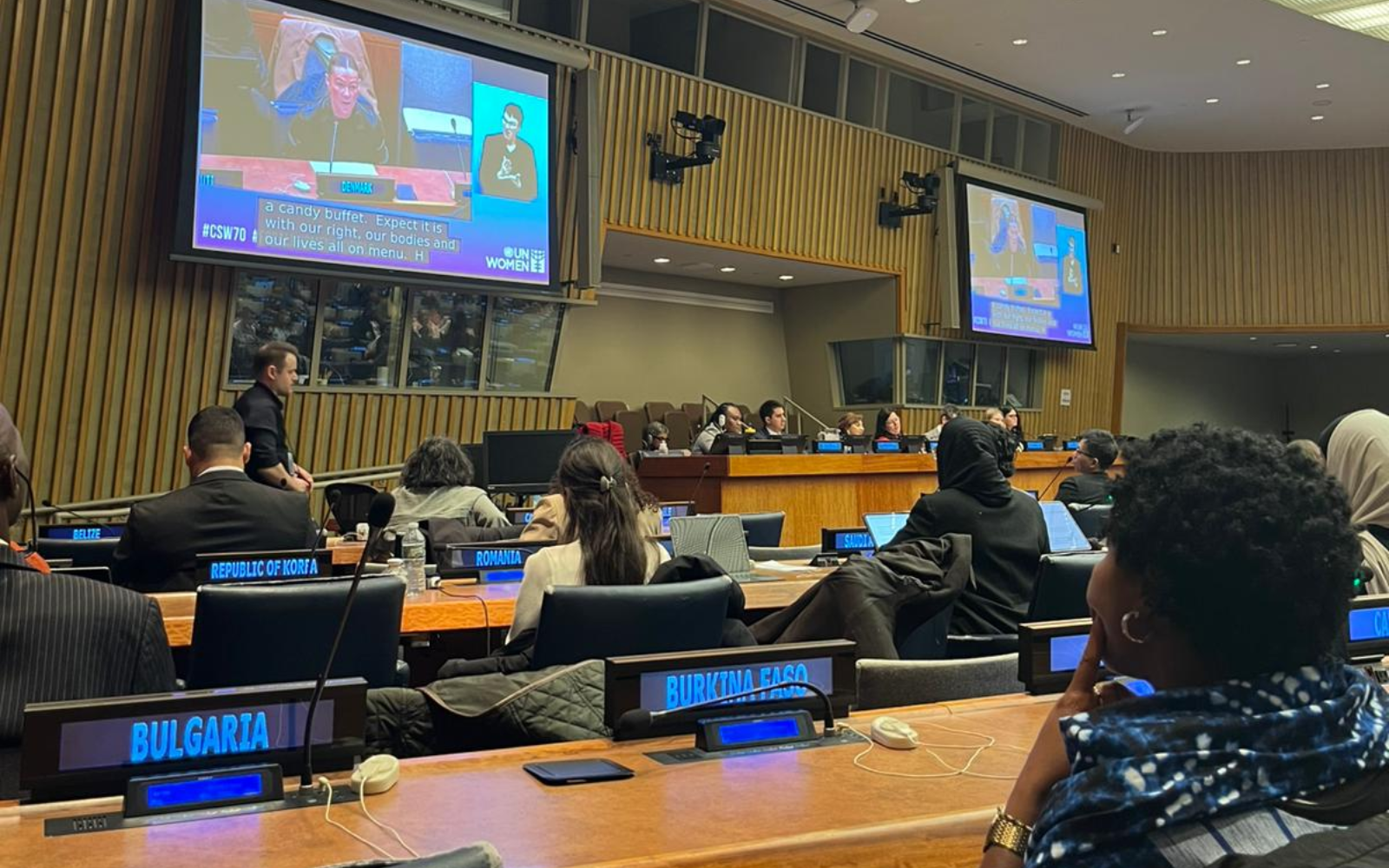
*UN Headquarters, Conference Room 4 – Interactive Youth Dialogue: Ensuring and Strengthening Access to Justice for All Women and Girls*
As every year, the UN Under-Secretary-General and UN Women Executive Director, Sima Bahous, together with other representatives of the UN, including the Assistant Secretary-General for Youth Affairs, Dr. Felipe Paullier, opened the discussion with the Youth Delegations. Within CSW70, the objective of this dialogue has been to highlight barriers and solutions to advancing access to justice through diverse approaches.
In the current context of growing social and political challenges, where increasing numbers of women and girls face instability and live in areas where not only justice but especially peace, can no longer be taken for granted, it is essential to ensure and strengthen the mechanism that will support this access by including all relevant voices. As emphasised by the Under-Secretary-General and UN Women Executive Director, this cannot remain merely a policy objective; it is the cornerstone upon which all other rights depend.
As emphasised by the Chair, young leaders and activists play a critical role, as they are uniquely positioned to challenge discriminatory laws, institutional biases, and weak enforcement mechanisms that continue to constrain justice outcomes for women and girls worldwide, particularly for young women who face distinct and intersecting barriers that limit their ability to claim their rights.
In the 2025 review of the Beijing Platform for Action, 77 per cent of countries identified access to justice as a top priority, while 90 per cent reported recent measures to strengthen legislation addressing violence against women and girls. In this direction, the Agreed Conclusions of CSW70 call for gender-responsive legal reform, protection in the world of work, recognition of communities, gender-responsive transitional justice, and robust data to inform policy and action. This is why the discussion with young leaders and activists highlighted that the access to justice for all women and girls must be recognised as an indispensable right.
As an outcome of the discussion, I would like to highlight the words of the Under-Secretary-General, who emphasised that, as young leaders and activists, we must believe in our capacity to achieve change. We are the ones capable of rewriting laws. If we act in a coordinated way, we can build new systems. We have the power; and therefore, we must also have the courage.
Before opening the discussion to the Youth Delegates, whose contributions highlighted how backlash against women and girls’ rights is structurally present across all contexts, five speakers stressed the urgent need for cooperation among stakeholders to counter this growing trend. Nauna Revo (from Solomon Islands), Oona Kurpa (from Finland), Ekaterine Muzashvili (from Georgia), Sandy Joseph (from Haiti), and Rania Hogga (from Morocco) called for survivor-centred approaches, stronger accountability (including in digital spaces), inclusive policies for marginalised groups, and sustained investment in youth-led initiatives to drive meaningful and lasting change.
The speeches of the Youth Delegates from all over the world reinforce the need for inclusive gender equality efforts that recognise the diversity of women and girls, as well as the importance of mental health support for survivors of gender-based violence. They also highlight the need for meaningful youth participation in justice systems, equal access to education and digital literacy, and the creation of safe and trusted support mechanisms for survivors.
These priorities underscore the importance of strong collaboration among policymakers, civil society, and all actors involved in ensuring access to justice, including the private sector and educational institutions. In this context, Soroptimist International plays a central role due to its global presence. Our work as SI delegates is essential to coordinate efforts, contribute across working groups, and advance a shared, strategic, and well-planned approach. We must be the voice of those women and girls who are not present, yet who confront the system with courage every day, advocating for change.
Finally, the Assistant Secretary-General for Youth Affairs emphasised that young people are already leading innovative solutions to dismantle structural barriers, but require institutional support, protection of their rights, and inclusive participation, especially in contexts of shrinking civic space, conflict, and exclusion. Access to justice depends on peace, meaningful youth engagement, and sustained, flexible funding, calling on institutions to match the ambition of young leaders with concrete resources and action.
Building on this, we, as Soroptimists, need to engage in more sustained and coordinated efforts, fostering continuous dialogue among young members to strengthen collaboration with representatives of different delegations. This will ensure that the work carried out at the local level is elevated as evidence, as a basis for discussion, and as a best practice in international forums. Indeed, the opportunities offered by our global network must be fully leveraged, especially at a time when justice remains uncertain, and even peace cannot be taken for granted.
This blog aligns with Soroptimist International’s pillars on violence against women, empowerment, and education, highlighting the importance of youth leadership in advocating for justice and equality.









