Sarah Barnbrook, Soroptimist International representative to the World Summit on the Information Society (WSIS) Forum 2026, blogs from Session 252, ‘Young people’s mental health in an online world’.
At WSIS Forum 2026 in Geneva, the Permanent Mission of Belgium Wallonia-Bruxelles hosted Session 252 on young people’s mental health in an online world, delivered in French and English with interpretation and moderated by Alexandre Carette of the United Nations in Geneva. The panel included psychologist and psychotherapist Niels Weber, media literacy specialist Tatiana Debrabandere and Daniella Esi Darlington, CEO and co-founder of Alleina AI in Ghana. Between them, they made a case for moving the conversation well beyond screen time, and the case they made has direct relevance to Soroptimist International’s advocacy on education and gender equality.
Weber opened by challenging one of the most common assumptions in public debate: that screen time hours are a useful measure of a young person’s wellbeing. He argued the more meaningful questions are what young people are actually doing online, what need that activity is meeting, and what’s happening in the rest of their life. A teenager gaming for three hours with friends after a hard day at school is in a different situation to a teenager scrolling alone at 2am because they can’t sleep and have no one to talk to. Same screen, similar hours, different story.
According to Weber, screen use is not a developmental need in itself. It’s a behaviour that stands in for one, whether that’s connection, escape, belonging or simply relief from boredom. Measuring hours alone misses the need underneath.
Weber also cautioned against describing most problematic technology use as “addiction.” He pointed instead to retention mechanics deliberately built into digital products to keep users engaged longer than intended. Children and adolescents, whose executive functioning is still developing, are more vulnerable to this design, and girls in particular are targeted by mechanics built around appearance, comparison and validation.
That distinction has policy consequences. Framing the issue as a child’s lack of self-control leads toward more restriction and surveillance of kids. Framing it as commercial design working as intended leads toward platform accountability. The second framing is the one that protects the rights of the girls and young women these policies are meant to serve.
Debrabandere outlined Belgium’s approach to media literacy, which is legislated as a lifelong capability rather than a single school lesson, covering children, young people, parents, educators and older adults. She noted that understanding a young person’s online life requires engaging with the platforms they actually use, the creators they follow and the spaces where their social world plays out, rather than legislating from a position of limited familiarity with those spaces. This kind of education-based empowerment is consistent with Soroptimist’s long-standing approach: equipping women and girls with the tools to navigate the world as it actually is.
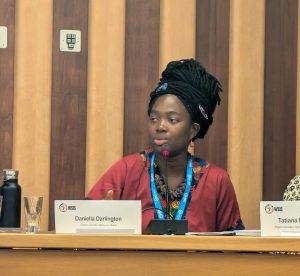
Daniella Darlington, CEO/Co‑founder Aileen AI, Ghana.
Darlington, speaking from her own experience building responsible AI practice in Ghana, argued that young people should not be treated as passive recipients of policy. They are active participants in shaping digital futures, and solutions built without their input risk misreading both the problem and the opportunity. This aligns with the UN Global Digital Compact’s emphasis on inclusive, participatory governance, and with Soroptimist’s own position that those affected by a policy should help write it.
On family communication, Weber suggested replacing screen time limits with a different question: what does my child need to be thriving? Friendships, physical activity, sleep, learning and family connection were the factors he named. When those are in place, time online becomes one part of a larger picture rather than the central concern. He described using video games therapeutically, playing alongside young clients to understand what the game means to them rather than to monitor their use, and said parents who try this often see communication improve.
On regulation, several panellists questioned whether raising the minimum age for social media access addresses the underlying problem. They argued for closer scrutiny of the commercial incentives behind platforms, given that engagement-maximising algorithms are not transparent to users and are built to reward attention over wellbeing.
This is the area where Soroptimist’s UN representatives, working across five UN Centres, are positioned to apply pressure, alongside existing work on education and gender equality.
The panel’s overall position was that no single intervention solves this problem. Effective protection combines media literacy, responsible platform design, mental health support, meaningful youth participation, informed parenting and evidence-based regulation. Young people are not the problem, and technology is not inherently harmful.
The task is building digital environments that take children’s rights seriously and place their wellbeing at the centre of platform design, rather than treating it as an afterthought once harm has occurred. For Soroptimist, that is a current and material part of the education and gender equality mandate, not a separate issue.
The themes raised in this session are consistent with the work I lead as Co-Lead of Soroptimist International Australia’s Digital Safety Futures Project, alongside my Co-Lead Lou De Castro Myles, and with the direction we have been pushing nationally: move past the screen time debate, focus on what is driving the harm, and bring young people, particularly girls, into the policy process rather than legislating over their heads.
Girls and young women don’t experience the online world the same way their male peers do. The harassment is more sexualised, the pressure to perform a certain kind of appearance starts earlier, and the platforms that promise connection are often the same ones exposing them to exploitation, image-based abuse and grooming.
For girls in the Global South, digital vulnerability rarely arrives on its own. It compounds existing barriers to education, sits alongside already elevated rates of gender-based violence, and is met with far less access to digital literacy resources than girls in wealthier nations have. A girl navigating a predatory platform with no local media literacy program, no accessible reporting pathway and no established support network is carrying several risks at once, not one.
That compounding effect is precisely why progress in this space depends on governments, educators, industry, families and civil society engaging with each other and with the young people at the centre of it.