On a September morning in 2020, a runner in Oakland, California, stepped out before dawn — and the sun never rose. The sky over San Francisco Bay stayed dark, then turned an eerie orange she compared to a scene from Blade Runner. Terrified, she ran home and phoned her father three thousand miles away, just to describe it. “I’ve never seen anything like it.”
Six years later, the whole world has had a front row seat to the same horrifying vision. This summer France mounted its largest civilian evacuation since wartime, with President Macron describing the wildfires as “the toughest situation since the Second World War.” Spain also suffered the biggest fire in its recorded history, while smoke from remote Canadian fires drifted south and killed people in New York City.
That is the truth we need every Soroptimist to understand: the flames are part of the story, but the smoke is the headline.
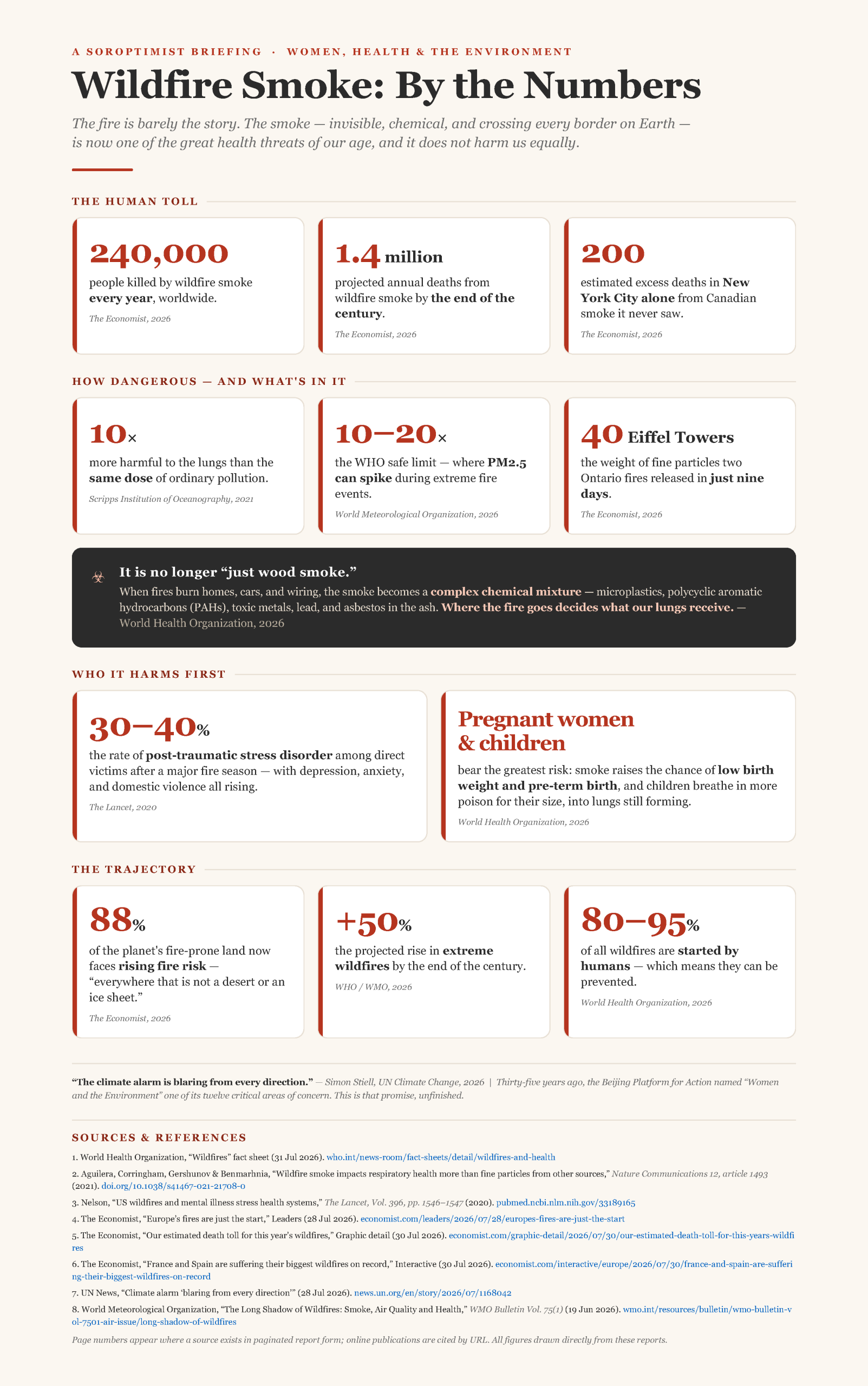
And experts are aware that what they are talking about is no longer “just wood smoke.” As fires burn through our homes, cars, and wiring, the World Health Organisation now describes the smoke for what it really is: “a complex mixture” of toxic metals, polycyclic aromatic hydrocarbons, lead — and microplastics. All waiting to get into our lungs and bloodstream. Its 2026 warning is chilling:
“When wildfires burn manufactured structures and materials, additional chemicals are added to the smoke, with ash containing higher levels of toxic trace metals, asbestos and PAHs.” — World Health Organisation, 2026
Where the fire goes decides what our lungs receive. This type of pollution is not the one that many have learned to tolerate. Scientists at the Scripps Institution of Oceanography found wildfire smoke up to ten times more harmful to the lungs than the same amount of ordinary pollution. For decades, regulators assumed a particle was a particle. They were wrong.
The harm does not fall evenly — which is exactly why this is our fight. The WHO warns that pregnant women exposed to wildfire smoke face higher risks of low birth weight and pre-term birth; the smoke reaches the child before the first breath. Children absorb a larger dose than adults because their lungs are still forming and they breathe more air for their size. Moreover, when the flames recede, the wound that never shows on an X-ray remains: after a major fire season, post-traumatic stress disorder affects 30 to 40 percent of direct victims, with depression, anxiety, and domestic violence all rising. Fire, one psychiatrist acknowledged, is “a very potent trauma.”
The numbers are the alarm bell that has been ringing for several years now. Wildfire smoke already kills an estimated 240,000 people a year, and its toll is projected to reach 1.4 million a year by century’s end. Fire risk is now also climbing across 88 percent of the planet’s fire-prone land. The UN’s climate chief, Simon Stiell, put it starkly this summer: “The climate alarm is blaring from every direction.”
We must refuse to call this “the new normal.” As The Economist reminds us, fire “is capricious; it does not repeat itself from one year to the next.” The harder truth: these fires have moved from isolated incidents to being “firmly within the limits of the new possible — and the extremities of that new possible have yet to be mapped.”
Thirty-five years ago, the Beijing Platform for Action named “Women and the Environment” one of its twelve critical areas of concern. As women who have never feared being the first voice in the room, our task is to educate our family, communities, regions and the world regarding what horrifying visions await us if our world does not deal with the factors which cause this. First we get their attention. Then, together, we get everyone else’s.
Drawn from nine sources (2020–2026): the World Health Organisation “Wildfires” fact sheet (2026); Aguilera et al., Scripps Institution of Oceanography / UC San Diego, Nature Communications (2021); The Lancet (2020); The Economist (July 2026); UN Climate Change (2026); and the World Meteorological Organisation Bulletin (2026). All quotations are drawn directly from these sources.
Sources & References
Links as they appeared in the original source compilation. Page numbers are given where a source exists in paginated report form; the WHO, Economist, UN, and WMO items are online publications cited by URL (and, where useful, by section).
- World Health Organisation. “Wildfires” (fact sheet), 31 July 2026. https://www.who.int/news-room/fact-sheets/detail/wildfires-and-health
Cited for: online fact sheet, no page numbers. The “complex mixture… microplastics, PAHs, lead, asbestos” list and the “manufactured structures” quote (§ Wildfires and air pollution; § Health impacts); ~90% of particle mass as PM2.5; pregnant-women and children vulnerability (§ Populations at risk); 80–95% human ignition (§ Overview).
- Aguilera, R., Corringham, T., Gershunov, A. & Benmarhnia, T. “Wildfire smoke impacts respiratory health more than fine particles from other sources: observational evidence from Southern California.” Nature Communications 12, article 1493 (5 March 2021). https://doi.org/10.1038/s41467-021-21708-0
Cited for: peer-reviewed article no. 1493. “Up to ten times more harmful” (Abstract; Results); “may be inaccurate” (§ Implications for public health and air quality policy).
- Nelson, R. “US wildfires and mental illness stress health systems.” The Lancet, Vol. 396, pp. 1546–1547 (14 November 2020). https://pubmed.ncbi.nlm.nih.gov/33189165/
Cited for: print report — page numbers apply. PTSD at 30–40% among direct victims; fire as “a very potent trauma” (pp. 1546–1547).
- The Economist. “Europe’s fires are just the start” (Leaders), 28 July 2026. https://www.economist.com/leaders/2026/07/28/europes-fires-are-just-the-start
Cited for: online article, no page numbers. 240,000/yr and 1.4 million/yr projections; “88%… not a desert or an ice sheet”; “fire is capricious…”; “the new possible… have yet to be mapped.”
- The Economist. “Our estimated death toll for this year’s wildfires” (Graphic detail), 30 July 2026 https://www.economist.com/graphic-detail/2026/07/30/our-estimated-death-toll-for-this-years-wildfires
Cited for: online article. ~200 excess deaths in New York City from Ontario smoke.
- The Economist. “France and Spain are suffering their biggest wildfires on record” (Interactive — Europe), 30 July 2026. https://www.economist.com/interactive/europe/2026/07/30/france-and-spain-are-suffering-their-biggest-wildfires-on-record
Cited for: online article. France’s largest civilian evacuation since wartime; Macron’s “toughest situation since the Second World War”; Spain’s biggest fire on record.
- UN News (United Nations). “Climate alarm ‘blaring from every direction,’” 28 July 2026. [Labeled “The Economist” in the compilation; the underlying source is UN News, quoting UN Climate Change chief Simon Stiell.] https://news.un.org/en/story/2026/07/1168042
Cited for: online article. “The climate alarm is blaring from every direction.”
- World Meteorological Organisation. “The Long Shadow of Wildfires: Smoke, Air Quality and Health.” WMO Bulletin, Vol. 75(1) — The Air Issue, 19 June 2026. https://wmo.int/resources/bulletin/wmo-bulletin-vol-7501-air-issue/long-shadow-of-wildfires-smoke-air-quality-and-health
Cited for: online bulletin (print Vol. 75(1); online version unpaginated). Smoke crossing “borders, oceans, and continents”; PM2.5 10–20× the WHO limit in extreme events.