


Blog by Evelyne Para, Soroptimist International Representative at UNESCO, Paris.
Among the top students in Mathematics and Science, fewer girls than boys aspire to careers in STEM (Science, Technology, Engineering, and Mathematics).
During a recent event at UNESCO Paris, held to present the GEM 2026 Education Report on “Access and Equity,” I had the opportunity to participate in discussions focusing on the growing gap between girls and boys regarding the involvement of future generations in STEM development.
Many questions were posed to the speakers: What are the potential implications of these findings for the future? What measures can be taken to improve girls’ performance in Mathematics? What research should be explored?
Here is a brief summary of these discussions.
A worrying observation
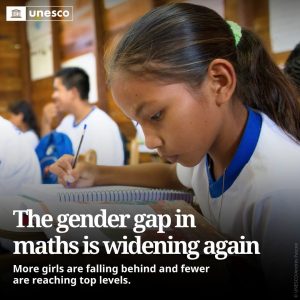
It has long been observed in education systems that mathematics performance varies according to gender. Girls had made progress in several countries in recent years. However, since 2019, data reveals that the gender gap is widening, and girls are once again falling behind. This worrying trend is particularly pronounced at the end of primary school, but it is also observed at the end of lower secondary school.
Furthermore, among the top students in mathematics and science, fewer girls than boys aspire to work in these fields. Thus, valuable talent is being lost.
This is a cause for concern, as strong mathematical skills are essential for driving economic and social development, fostering innovation, and finding solutions to pressing global challenges. The fields of science, technology, engineering and mathematics (STEM) are essential to addressing global challenges such as health technologies, climate change and the scarcity of natural resources, or the development of Artificial Intelligence (AI).
For example, until recently, in member countries of the Organisation for Economic Co-operation and Development (OECD), only 30% of students starting a bachelor’s degree in STEM were women. Furthermore, globally, the proportion of women studying engineering, manufacturing and construction, or information and communication technologies (ICT) was below 25% in more than two-thirds of countries.
Yet, studies show that by the end of middle school (Year 8), in many countries, girls outperform boys in these subjects. Clearly, factors other than scientific and mathematical knowledge and skills are at play.
Analysis of the results of the studies conducted
Boys report having significantly more confidence in their mathematical abilities than girls. In other scientific subjects (biology, chemistry, etc.), girls have significantly more confidence in their abilities than boys.
It is important to analyse the relationship between students’ gender, their self-confidence and their performance in mathematics and science, on the one hand, and their aspirations to pursue STEM fields, on the other.
According to studies conducted in partnership with UNESCO, which analysed changes over time in a sample of approximately fifty distinct education systems, these differences are generally associated with the persistence of gender stereotypes, teacher expectations, classroom interactions, variations in students’ self-confidence and confidence in their mathematical abilities, and unequal levels of participation in math-related activities.
Girls’ confidence in their abilities in mathematics and science is likely to be undermined by their peers, parents, teachers, and guidance counselors, who perpetuate, or even reinforce, gender stereotypes in STEM. These factors include social, cultural, and gender norms that influence how girls and boys are raised, learn, and interact with their parents, family, friends, teachers, and the wider community, and that shape their identity, beliefs, behavior, and choices.
Targeted efforts must be made
The results of this study highlight the need for early, ongoing, and differentiated responses. Efforts must be made to:
– Build girls’ confidence in their mathematical abilities early on by integrating playful activities, spatial visualisation, and problem-solving into primary school curricula to foster a positive image of mathematics;
– Integrate gender-transformative pedagogy into teacher training to equip teachers with the necessary tools to identify and combat gender bias and promote more equitable interaction and participation in mathematics classrooms;
– Promote active and cooperative learning that emphasises problem-solving, student interaction, and learning from mistakes in a low-stress environment, thereby reducing gender gaps in mathematics.
– Promote supportive family and community environments that combat gender stereotypes, enhance the visibility of role models, and value girls’ potential in mathematics and STEM fields.
Guidance counselors should encourage girls who perform well in mathematics and science to pursue further studies in these fields. Informal activities, such as clubs and extracurricular activities, as well as STEM internships for secondary school girls, have proven effective in sparking girls’ interest in STEM and building their self-confidence. Furthermore, interventions involving female role models have been shown to increase girls’ confidence in their STEM abilities. Schools should therefore highlight mentors and role models, including successful women in these fields. Parents should also be involved. Parent outreach programs can help dismantle harmful gender stereotypes about women in STEM.
To combat stereotypes and encourage girls to pursue careers in mathematics, broader social measures are also essential, including gender equality policies, public awareness campaigns, and comprehensive career guidance services. Doing so moves us all toward gender equality in education, where women and men, boys and girls can participate fully, thrive, and create a more inclusive, equitable, and sustainable world.
In conclusion,
STEM fields underpin the 2030 Agenda for Sustainable Development, and STEM education can provide learners with the knowledge, skills, and behaviors necessary for inclusive and sustainable societies. Leaving girls and women out of this education and these careers is a loss for everyone. Solutions exist, and the NGO Soroptimist International is working to promote girls’ and women’s interest in STEM.









