

Blog by Elena Kerr, SI Edinburgh (SIGBI)
SI CSW70 Delegate
17/03/2026
CSW70 Side Event – How Systems Fail Survivors: the Role of Justice and Financial Institutions in Causing – and Combating – Sexual Exploitation and Trafficking
Survivor-Centred Approaches and Systemic Failures
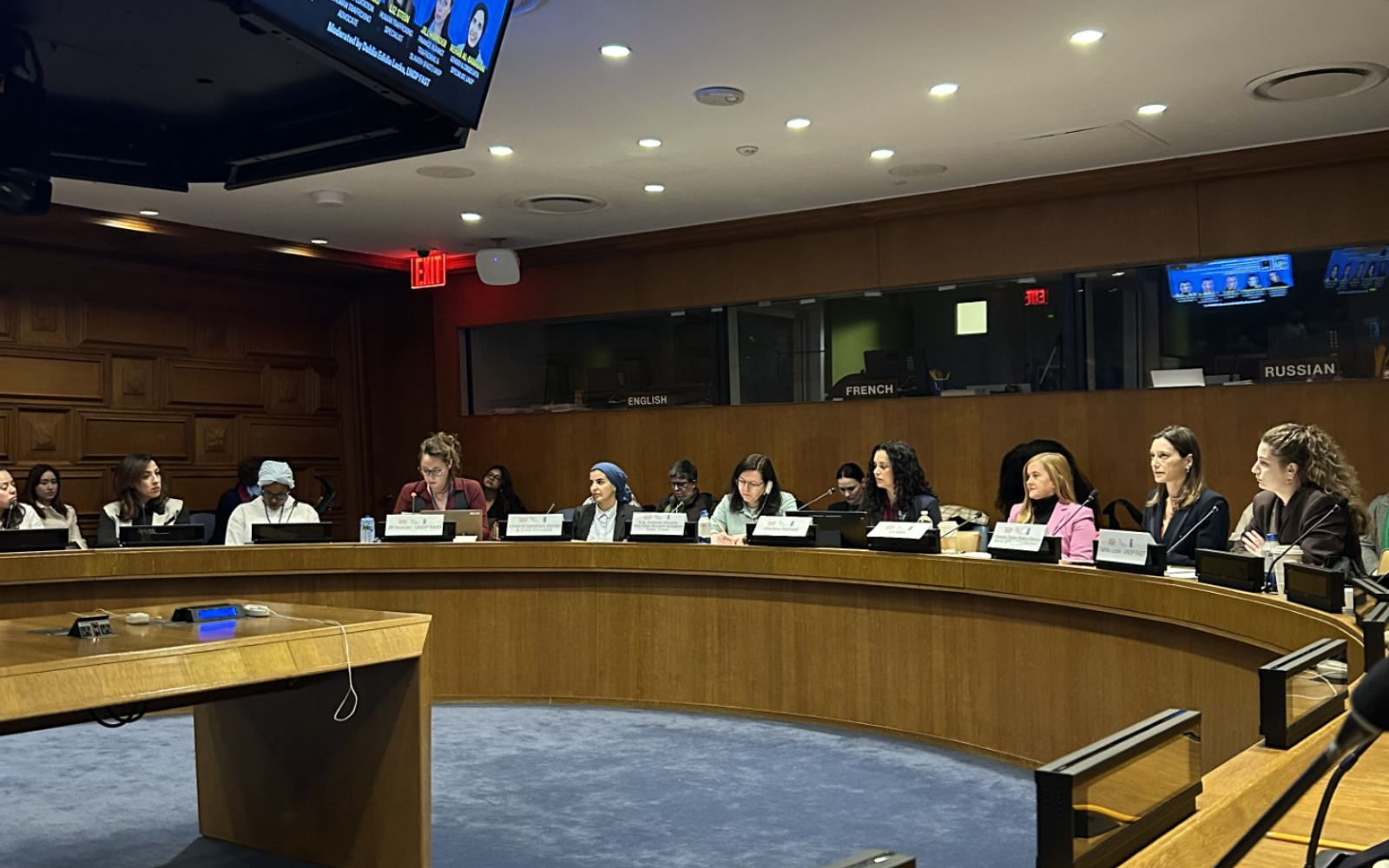
Today I attended this event hosted by FAST (Finance Against Slavery & Trafficking), World Without Exploitation, and the United Nations Development Programme (UNDP). The panel included expert speakers Rebecca Zipkin, Sharlene Rochard, Liz Stein, Jill Hunder, and Rehab Al-Sanabani. The event was moderated by Dahlia Edidin Locke and included welcome remarks from the Special Rapporteur on Violence Against Women and Girls, Reem Alsalem. The event was concluded and summarised by H.E. Andrea Mocano, Deputy Permanent Representative of Romania to the United Nations (UN).
Reem opened the event by emphasising the importance of survivor-centred approaches. Survivors of sexual exploitation and trafficking are often minimised and dismissed by policy systems that should protect them. Survivors must not be criminalised for crimes they were forced to commit. Another key aspect of the justice system is confidentiality, which is an obligation; survivors should not live with the fear of their trauma being exposed. The exposure of survivors’ trauma deters others from coming forward and undermines the rule of law. Reem therefore called for stronger data protection.
Referring to the Epstein files, Reem highlighted how perpetrators of crimes against humanity are shielded by power. Poorly managed disclosure undermines law, and accountability cannot be negotiated through financial and power systems. She questioned why warning signs in the Epstein case were not acted on, pointing to the financial systems that enabled this. This reinforced the need to close legal and policy gaps that allow abuse and exploitation. Reem also emphasised that no one can consent to their own exploitation, and that prevention must therefore address demand. Trafficking is a transnational process and requires shared knowledge systems. She called for systemic change, with survivors at the centre, rather than institutions and those in power.
Demand, Accountability, and the Role of Systems
Rebecca contributed to the discussion through language and terminology. She encouraged moving away from the term “sex work” towards “sex trafficking” and “prostitution”, due to the exploitation involved. She argued that “sex work” is not work but a form of gender-based violence. The commercial sex market is growing, particularly in relation to the exploitation of children. The term “child” or “minor sex worker” is not used, as this is considered trafficking.
The largest risk factor for human trafficking is vulnerability and instability, where buyers are men with greater economic and social power. Referencing the Epstein case, Rebecca noted that wealthy and powerful men bought vulnerable girls, with many others involved in facilitating abuse, including pilots, drivers, housekeepers, and doctors. This raises the question of accountability: who facilitated and who profited.
Rebecca emphasised that demand drives trafficking. Commercial sex buying is increasingly moving online, where access to pornography and social media is normalising exploitation, and grooming is seen as flattering. It is easier to buy sex online due to anonymity. She also raised the concern that buyers are becoming younger, with boys exposed to pornography at an early age and becoming desensitised through this normalisation.
In discussing solutions, Rebecca referred to a survivor-centred model first implemented in Sweden in 1999, which holds buyers accountable while supporting women through social services when exiting. In this model, the buyer is criminalised, not the survivor. Prostituted individuals are decriminalised, and buyers are recognised as exploiters. This approach has increased criminal investigations into sex trafficking. She highlighted that justice should not expire, and that systems and legal frameworks must listen to survivors.
Liz, as a survivor of Epstein, contributed a strong perspective as a current human trafficking specialist. The Epstein case illustrates criminal behaviour, not a political issue, and demonstrates how systems protect powerful men. This reflects a business model of exploitation. Liz also noted that the use of the term “sex work” in public policy normalises buying sex. The survivor-centred model offers an alternative, where criminalising the buyer reduces demand and makes trafficking less profitable. She also explained how trafficking distorts a person’s sense of reality, and how systems often fail to understand the psychology of abuse. Networks and financial institutions must therefore be held accountable, and survivors must be included in policy development.
Sharlene, also a survivor of Epstein, contributed by highlighting the intersection of power imbalances, weak justice systems, and gender, and how this constitutes crimes against humanity. She emphasised that children cannot consent when the perpetrator is in a position of power. There must be no delay, deflection, or loss of evidence. Responses must be trauma-informed and survivor-centred, recognising women as human beings, not evidence.
Rehab added that survivors are not only harmed by traffickers, but also by systems that fail to listen or respond effectively. Jill echoed the importance of engaging those with lived experience. H.E. Andrea Mocano summarised the discussion, highlighting key points including access to justice, survivor-centred policies, the courage to speak up, cross-national collaboration, and the need to follow financial flows to identify accountability.
Overall, this panel provided important insights into sexual exploitation and trafficking, alongside powerful testimonies that reinforced the need for systemic change.









