


Blog by Evelyne Para, SI Representative at UNESCO, Paris
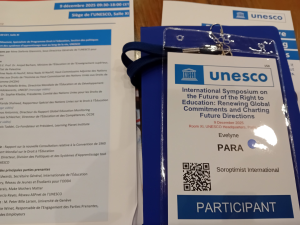
To mark the 65th anniversary of the 1960 Convention against Discrimination in Education, UNESCO organised a World Symposium on 9 December 2025 in Paris. As International Day of Education approaches on 24 January, this moment provides a timely opportunity to reflect on the progress made, the gaps that persist, and the future of the right to education. Through high-level presentations, expert roundtables, and thematic discussions, the Symposium brought together representatives of Member States, UN agencies, civil society, educators, researchers, youth, and other experts from around the world to take stock of achievements and to help chart the course ahead for this fundamental human right.
As Soroptimist International’s (SI) Representative to the United Nations in Paris (UNESCO), Evelyne Para had the opportunity to participate in this event and provide a summary.
2025: a decisive turning point
The year 2025 marks a decisive turning point for the realisation of the right to education worldwide. As the international community enters the final four years toward achieving the Sustainable Development Goals (SDGs) by 2030—particularly SDG 4 on quality education and lifelong learning—it is more urgent than ever to accelerate efforts in this area.
Since the adoption of the Convention in 1960 and the Education 2030 Agenda, significant progress has been made. Access to free primary education has expanded considerably: 82% of countries now offer free basic education, compared to 56% in 2000. School completion rates have improved, and higher education enrolment has grown from 100 million students in 2000 to 264 million today, including in least developed countries. Gender parity is also close to being achieved in many regions.
However, major challenges persist. Globally, 272 million children still drop out of school prematurely, while 762 million adults remain illiterate—two-thirds of them women. Persistent poverty, lack of trained teachers, inadequate infrastructure, political crises, and climate shocks continue to undermine educational access and quality. Inequalities between rich and poor, and between developed and developing countries, remain significant, particularly in access to digital tools and safe learning environments.
Climate, conflicts, and artificial intelligence
The Symposium highlighted how climate disruption, conflict, displacement, and artificial intelligence are placing increasing pressure on the right to education. In 2024 alone, more than 240 million students experienced educational disruption due to climate events. At the same time, conflicts continue to deprive millions of children of equitable learning opportunities.
The AI revolution presents both promise and risk. Speakers consistently emphasised the need for a human-centred approach to AI—one that augments rather than replaces human intelligence, protects ethics and data, and supports learning without eroding creativity, curiosity, and critical thinking. UNESCO therefore calls for robust regulatory frameworks, strengthened teacher training, and inclusive dialogue to ensure technology serves education equitably.
Conclusion
Expanding access to education is not enough. The right to education must guarantee quality learning that supports the full development of the human personality, promotes gender equality and democratic values, and fosters respect for human rights and fundamental freedoms. In the face of profound global transformations, education remains the most powerful means of accelerating social progress, strengthening social cohesion, and ensuring a just, equitable, and sustainable future for generations to come.









